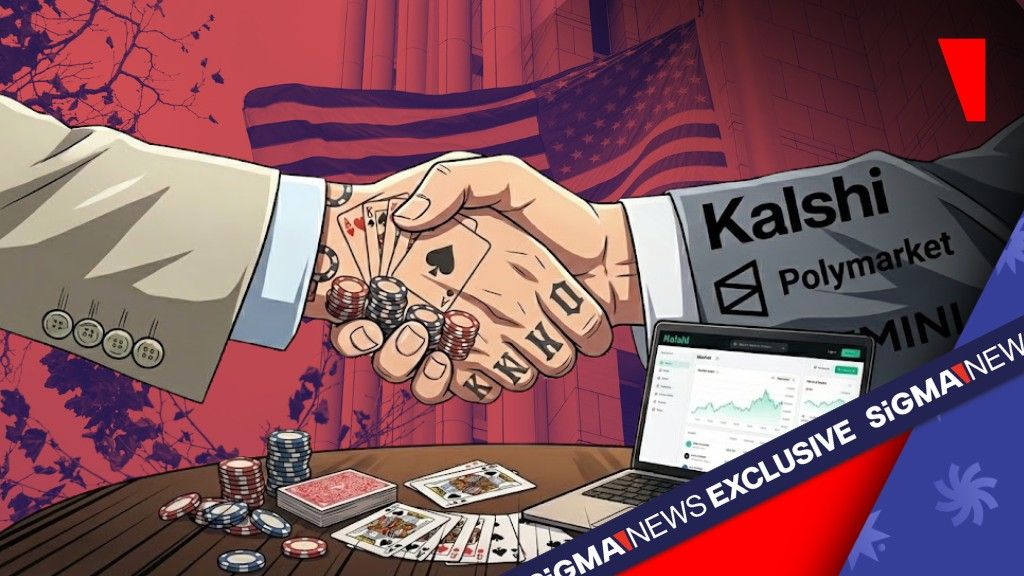
The global iGaming industry underwent a period of regulatory and market adjustment in 2025. Regulatory action in parts of Asia influenced existing operations, while prediction markets in the United States expanded in scale and participation.
Once considered a niche segment, prediction markets expanded rapidly across the US, drawing interest from both retail participants and institutional players. Over the past two years, a growing list of platforms has entered the space, including PrizePicks, Underdog, Novig and President Donald Trump’s Truth Predict. On 17 December 2025, crypto exchange Gemini launched its own prediction market platform, while Fanatics rolled out its offering earlier in the month, signalling growing confidence in the sector’s commercial viability.
The momentum is not confined to the US. In the UK, betting exchange Matchbook is preparing to launch a prediction market platform in January, positioning itself to compete with established US operators such as Kalshi and Polymarket. DraftKings has also moved closer to launching its predictions platform after receiving key federal approvals.
These developments point to one simple fact that operators are shifting as per consumer behaviour, and new forms of market participation are taking place. However, the growth of prediction markets has also intensified concerns among established gaming stakeholders.
AGA hits back at predictors
The American Gaming Association (AGA) has emerged as one of the most vocal critics. Bill Miller, the President and CEO of the American Gaming Association (AGA), has openly stated that prediction platforms threaten the existing regulatory ecosystem. “They’re threatening the communities we serve, the customers and consumers we protect, and the standards we uphold.”
Miller argues that prediction platforms were seeking market access without accepting the compliance obligations faced by licensed gaming operators. “They want the opportunity, but they don’t want the compliance,” he said, warning that such models could undermine consumer protection and regulatory oversight.
AGA vs CPM: an open conflict
As tensions have grown, prediction market operators have begun organising independently. Kalshi and Crypto.com recently announced the formation of the Coalition for Prediction Markets (CPM), a new national industry body that also includes Coinbase, Robinhood and Underdog. The coalition aims to advocate for federally supervised, transparent access to prediction markets across the US.
The move comes amid rapid growth in the sector. According to a Kalshi-commissioned poll, nearly half of Americans under the age of 45 have used an online financial or prediction market. Trading volumes have surged, with total activity reportedly reaching $28 billion through October, including $4.4 billion recorded by Kalshi in a single month.
CPM argues that prediction markets fall under federal commodities law and warns that a fragmented, state-by-state regulatory approach risks driving consumers towards offshore platforms while weakening safeguards against insider trading and market manipulation.
2026, a turning point?
The widening divide has set the stage for a regulatory confrontation that could shape the future of wagering in the US and beyond. But for how long can traditional sportsbooks and prediction platforms continue to challenge each other, and what might 2026 hold? To explore whether confrontation or coexistence lies ahead, SiGMA News spoke with Stephen Crystal, Founder and CEO of SCCG Management.
“Those who cling to old rulebooks risk being left behind as the market moves on without them.”
-Stephen Crystal, Founder and CEO, SCCG Management
Crystal believes the industry is approaching a critical regulatory crossroads. “The convergence of prediction markets and traditional sports betting is reaching a critical juncture,” he said. “Event contracts don’t fit neatly into 20th-century gaming laws, yet regulators are trying to force them into outdated frameworks.” According to Crystal, this mismatch is driving an inevitable clash between federal oversight and state-based gambling regimes.
The seriousness of the shift, he argued, is reflected in the decisions some operators have already made. “The fact that operators were willing to leave the American Gaming Association and even surrender Nevada licences shows how seriously they view prediction markets,” Crystal said. “Walking away from the gambling capital of the US wasn’t symbolic, it was a statement that these products represent the future of wagering, not a side experiment.”
At the state level, resistance has hardened. “State regulators have drawn hard lines, banning sports event contracts and warning operators that even indirect involvement could cost them their licences,” Crystal said, describing a fragmented regulatory patchwork that has forced companies to geofence services, withdraw from markets or limit products to avoid jurisdictional conflict.
Tensions are particularly acute in tribal gaming jurisdictions. “For tribal gaming authorities, federally regulated prediction markets are seen as a direct encroachment on hard-won exclusivity,” Crystal explained, adding that these platforms are often viewed as “unlicenced sports betting operating under a federal loophole.”
As a result, the industry is increasingly divided. “Traditional casino-backed operators and regulators are fighting to protect the existing system,” Crystal said, “while tech platforms and innovative sportsbooks are pushing for a single, coherent federal framework.” He believes this divide is likely to widen before any compromise emerges.
Looking ahead, Crystal sees 2026 as a potential tipping point. “Regulators won’t be able to rely on outdated statutes forever,” he said. “Consumer demand is already there, investment is accelerating, and prediction markets are expanding into states that have never legalised sports betting.”
Ultimately, Crystal argues that resolution is unavoidable. “Prediction markets and traditional betting are on a collision course that demands resolution,” he said. “The industry can either evolve towards common-sense regulation or remain locked in legal and political battles that benefit no one.”
This article is quoted from: Sigma <"Reset looms for US sports betting, prediction markets in 2026"> original link: https://sigma.world/news/2026-deal-prediction-markets-and-betting/